Dr. Ahmet Özyiğit was born in 1981 in Famagusta, Cyprus. He is the youngest of three children of Özgen and Dr. Savaş Özyiğit.
After completing his high school education at Türk Maarif College in 1998, he earned his bachelor's and master's degrees in economics in Kansas, United States. He then received his doctorate in the same field, actively participating in academic research and publishing various scientific articles.
Over time, Dr. Özyiğit turned to medical science and completed his medical education at the University of Nicosia Faculty of Medicine. In addition to his medical education, he earned a master's degree in Clinical Embryology at the University of Leeds, and then pursued postgraduate studies in Endocrinology at the University of South Wales.
Dr. Özyiğit, who shaped her academic and clinical career with a multidisciplinary perspective, continues her clinical studies particularly in the areas of weight management, metabolic health, and healthy aging. An active member of the American Academy of Anti-Aging Medicine, Dr. Özyiğit earned American Board certification as a specialist in Anti-Aging and Regenerative Medicine after completing a fellowship in longevity medicine. In her clinical practice, she offers her patients longevity-focused approaches, weight management programs, reproductive medicine applications for the elderly, and treatments to support brain function.

Dr. Ahmet Özyiğit
Wellness and Anti-aging Applications

Dr. Ahmet Özyiğit
Wellness and Anti-aging Applications
A test that shows how long you will live: VO₂ Max
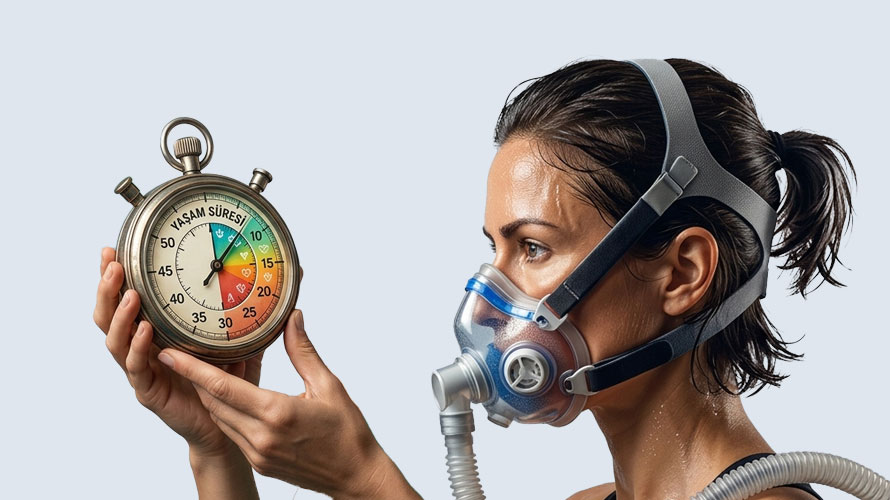
An Important Test That Shows How Long and Healthy You Will Live: VO₂ Max
You know your blood sugar. You track your cholesterol, blood pressure, weight, and perhaps body fat percentage. But do you know what your VO₂ Max is?
When it comes to a long and healthy life, VO₂ Max is one of the most important measurements to consider. This is because VO₂ Max is not just a sports performance metric indicating how fit we are; it's a crucial biomarker reflecting the body's overall functional capacity, assessing how efficiently the heart, lungs, circulatory system, and muscles can transport and utilize oxygen.
The scientific data is so strong that the American Heart Association considers cardiorespiratory capacity a key component in clinical assessment.vital signsHe argues that it should be treated as such. [1]
What is VO₂ Max?
VO₂ Max represents the maximum amount of oxygen your body can use in one minute during intense exercise. It is usually expressed as the amount of oxygen used per kilogram of body weight per minute, i.e., mL/kg/min. However, behind this simple number lies a rather complex physiology.
The oxygen you breathe needs to pass from your lungs into your blood, your heart needs to pump this oxygenated blood to your tissues, your blood vessels need to deliver it to your working muscles, and finally, your cells and mitochondria need to use this oxygen for energy production. Therefore, VO₂ Max actually evaluates not just a single organ, but an "oxygen chain":
Lungs → Heart → Vascular system → Muscles → Mitochondria
When the capacity of any link in this chain decreases, cardiorespiratory performance can also be limited. For this very reason, the American Heart Association defines cardiorespiratory capacity as a measure that reflects the integrated function of many organ systems and thus overall body health. [1]
Why is VO₂ Max so important?
What makes VO₂ Max and cardiorespiratory capacity particularly interesting from a longevity perspective is the magnitude of the relationship between them and long-term health outcomes.
In 2009 JAMA‘da yayımlanan önemli bir meta-analizde 33 çalışma incelendi. Tüm nedenlere bağlı ölüm açısından analiz edilen popülasyon 102.980 kişiden oluşan bir popülasyon idi. Bu meta-analizin sonucunda tespit edilen bulgu, egzersiz kapasitesindeki her 1 MET’lik artış, tüm nedenlere bağlı ölüm riskinde yaklaşık %13, koroner kalp hastalığı/kardiyovasküler olay riskinde ise yaklaşık %15 daha düşük risk ile ilişkiliydi. [2]
In other words, even relatively small differences in cardiorespiratory capacity appear to be associated with significant differences in long-term health.
Furthermore, one of the most notable studies on VO₂ Max was conducted in 2018. JAMA Network OpenPublished in [Year]. Cleveland Clinic researchers examined the exercise test results of 122,007 people to investigate the relationship between cardiorespiratory capacity and long-term mortality. The average follow-up period was 8.4 years. Participants were divided into low, below average, above average, high, and “elite” fitness groups according to their age and gender.
According to the study's results, the risk of death gradually decreased as cardiorespiratory capacity increased. Furthermore, the researchers did not identify an upper limit at which the benefit disappeared at very high fitness levels. The elite fitness group in the study was found to have the lowest adjusted all-cause mortality risk. [3]
These findings explain why VO₂ Max is so valuable in the field of longevity. In fact, the American Heart Association’s scientific statement points out that cardiorespiratory capacity can be a stronger predictor of mortality in some analyses than classic risk factors such as smoking, hypertension, high cholesterol and type 2 diabetes. [1]
Therefore, it's not accurate to view VO₂ Max solely as an answer to the question "how well can I run?". Rather, it should be about how well my heart, lungs, blood vessels, and muscles can meet the increased energy demand.
How to Measure VO₂ Max?
The most valuable approach in VO₂ Max measurement is the direct analysis of respiratory gases during exercise. While the individual exercises at gradually increasing intensity on a treadmill or bicycle, the oxygen and carbon dioxide concentrations and respiratory volume in their breath are measured in real time via a special mask.
Thus, instead of making estimates solely from heart rate or running speed, it is possible to measure how much oxygen a person actually consumes. During the test, numerous physiological parameters such as carbon dioxide production (VCO₂), respiratory exchange ratio (RER), ventilation, respiratory rate, tidal volume, O₂ pulse, and aerobic/anaerobic thresholds can also be evaluated along with VO₂.
Therefore, a well-conducted metabolic exercise test doesn't just provide a single VO₂ Max figure; it can offer much broader information about a person's cardiovascular, respiratory, and metabolic performance.
VO₂ Max Measurement in Northern Cyprus
Our hospital is the only one in Northern Cyprus that measures VO₂ Max, and we perform this assessment using the advanced PNOĒ cardiometabolic analysis system. The PNOĒ system analyzes oxygen and carbon dioxide in the air inhaled and exhaled during exercise in real time, allowing us to evaluate numerous parameters regarding cardiovascular performance, respiratory functions, and metabolic capacity, in addition to VO₂ Max. The system can analyze numerous cardiometabolic biomarkers, including VO₂/VO₂peak, VCO₂, RER, O₂ pulse, ventilation, and ventilatory thresholds.
Therefore, our goal is not simply to say "Your VO₂ Max is 35". What's truly important is assessing what this number means in relation to your age, gender, and overall health, and creating a personalized roadmap on how to increase it if needed.
What can be done if VO₂ Max is low?
One of the best features of VO₂ Max is that it is a modifiable indicator of health. Genetic factors influence initial capacity and response to exercise. However, regular aerobic exercise, and especially properly planned interval training, helps to significantly increase cardiorespiratory capacity.
A meta-analysis of 37 studies examining interval training showed an average increase of 0.51 L/min in VO₂ Max; the increase was even higher in some studies using longer high-intensity intervals. [4]
Another meta-analysis examining middle-aged and elderly individuals showed that both moderate-intensity continuous aerobic exercise and interval training increased VO₂ Max; interval training provided a greater increase on average. [5]
In practice, a good program often consists of a combination of two approaches:
- Improving the aerobic base through regular Zone 2 aerobic exercises,
- Pushing the limits of maximum aerobic capacity through high-intensity interval training tailored to the individual's health and fitness level.
- Resistance exercises are essential for preserving muscle mass and metabolic capacity.
- Sufficient sleep, recovery, and proper nutrition.
Moreover, the benefit of exercise to improve cardiorespiratory capacity is not limited to increasing VO₂ Max. Regular exercise can also have positive effects on blood pressure control, glucose metabolism, insulin sensitivity, body composition, endothelial function, and overall physical capacity. Therefore, when trying to increase VO₂ Max, we are actually training not just a single biomarker, but many physiological systems that support healthy aging simultaneously.
In the field of longevity, it's important not only to know our current state but also to see where we're heading over time. VO₂Max is extremely useful for this. The initial measurement shows us the starting point of our cardiorespiratory capacity. Based on this, a personalized exercise program can be created, and progress can be objectively evaluated by repeating the test after a certain period.
The goal may not be to become a professional athlete. The goal is for your heart, lungs, blood vessels, and muscles to still provide you with a high functional capacity when you reach 80 years old. Because longevity is not only about how many years we live, but also how strong, independent, and functional we are in those years. And today, scientific data tells us that VO₂ Max is one of the most valuable indicators we can use to track this capacity.
Sources
1. Ross R, Blair SN, Arena R, et al. Importance of Assessing Cardiorespiratory Fitness in Clinical Practice: A Case for Fitness as a Clinical Vital Sign. Circulation 2016;134:e653-e699. DOI: 10.1161/CIR.0000000000000461. (AHA Journals)
2. Kodama S, Saito K, Tanaka S, et al. Cardiorespiratory Fitness as a Quantitative Predictor of All-Cause Mortality and Cardiovascular Events in Healthy Men and Women: A Meta-analysis. JAMA. 2009;301(19):2024-2035. DOI: 10.1001/jama.2009.681. (JAMA Network)
3. Mandsager K, Harb S, Cremer P, et al. Association of Cardiorespiratory Fitness With Long-term Mortality Among Adults Undergoing Exercise Treadmill Testing. JAMA Network Open. 2018;1(6):e183605. DOI: 10.1001/jamanetworkopen.2018.3605. (JAMA Network)
4. Bacon AP, Carter RE, Ogle EA, Joyner MJ. VO₂max Trainability and High Intensity Interval Training in Humans: A Meta-Analysis. PLoS ONE. 2013;8(9):e73182. DOI: 10.1371/journal.pone.0073182. (PLOS)
5. Poon ETC, Wongpipit W, Ho RST, Wong SHS. Interval training versus moderate-intensity continuous training for cardiorespiratory fitness improvements in middle-aged and older adults: a systematic review and meta-analysis. Journal of Sports Sciences. 2021;39(17):1996-2005. DOI: 10.1080/02640414.2021.1912453. (PubMed)