Dr. Ahmet Özyiğit was born in 1981 in Famagusta, Cyprus. He is the youngest of three children of Özgen and Dr. Savaş Özyiğit.
After completing his high school education at Türk Maarif College in 1998, he earned his bachelor's and master's degrees in economics in Kansas, United States. He then received his doctorate in the same field, actively participating in academic research and publishing various scientific articles.
Over time, Dr. Özyiğit turned to medical science and completed his medical education at the University of Nicosia Faculty of Medicine. In addition to his medical education, he earned a master's degree in Clinical Embryology at the University of Leeds, and then pursued postgraduate studies in Endocrinology at the University of South Wales.
Dr. Özyiğit, who shaped her academic and clinical career with a multidisciplinary perspective, continues her clinical studies particularly in the areas of weight management, metabolic health, and healthy aging. An active member of the American Academy of Anti-Aging Medicine, Dr. Özyiğit earned American Board certification as a specialist in Anti-Aging and Regenerative Medicine after completing a fellowship in longevity medicine. In her clinical practice, she offers her patients longevity-focused approaches, weight management programs, reproductive medicine applications for the elderly, and treatments to support brain function.

Dr. Ahmet Özyiğit
Wellness and Anti-aging Applications

Dr. Ahmet Özyiğit
Wellness and Anti-aging Applications
PNOĒ
PNOĒ Metabolic Analysis and VO₂ Max Test
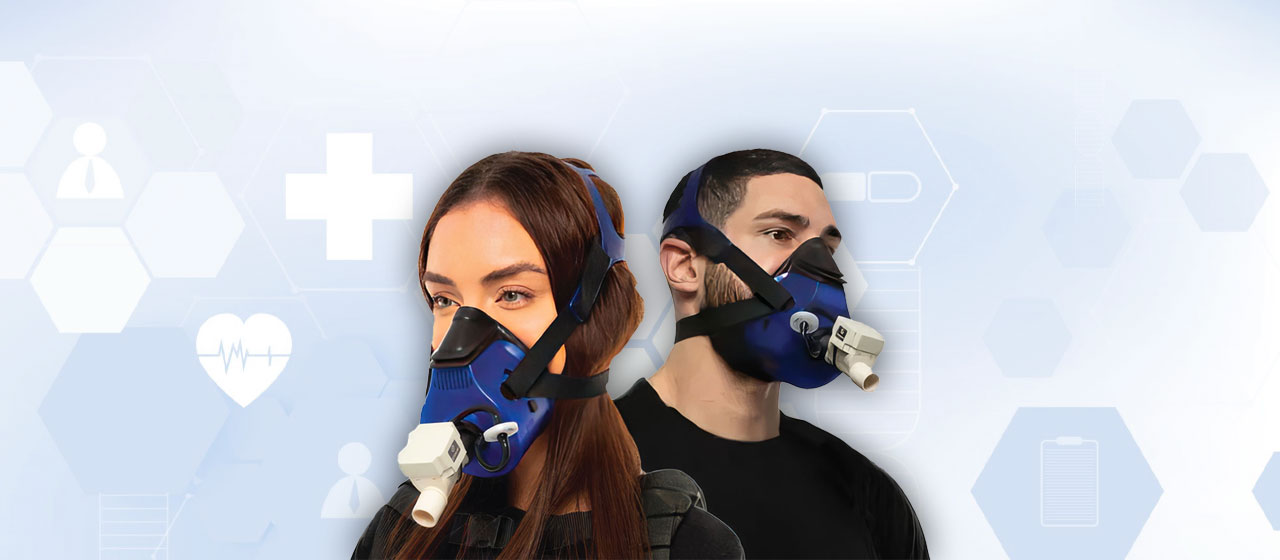
Imagine a health map of your body showing not just your weight, body fat percentage, or blood values, but also how it produces energy, how efficiently it uses oxygen, which fuels it prefers during exercise, and where its cardiorespiratory capacity stands in relation to its age… The PNOĒ metabolic analysis system offers exactly that test!
This technology, based on the analysis of respiratory gases, provides detailed information about metabolism and exercise physiology through the oxygen (O₂) inhaled and carbon dioxide (CO₂) exhaled. Thus, it becomes possible to assess not only how many calories a person burns, but also the energy sources from which those calories are obtained and how efficiently the cardiovascular, pulmonary, and muscular systems utilize oxygen.
What does the PNOĒ test tell us?
The PNOĒ system obtains numerous parameters regarding metabolism and cardiorespiratory capacity from respiratory analyses performed during rest and exercise. These include, in particular:
Resting Metabolic Rate (RMR) Test:
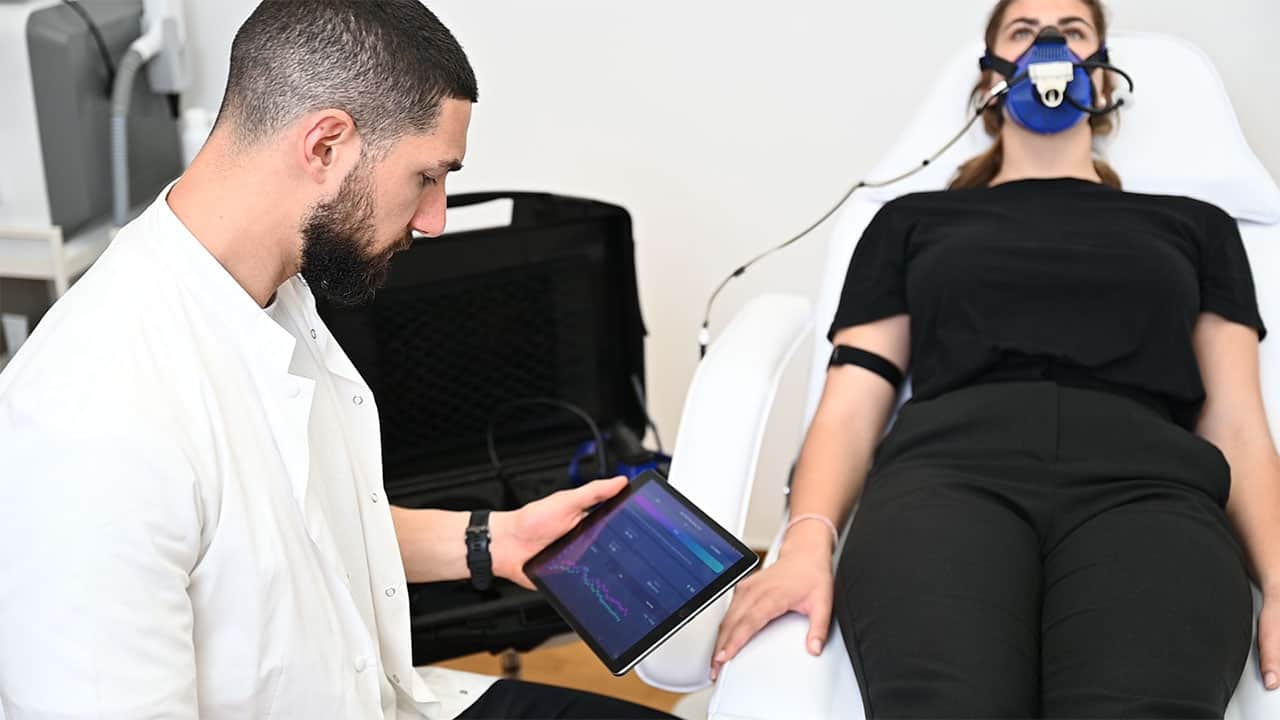
It shows the amount of energy the body expends to sustain life while at complete rest. In other words, it measures approximately how much energy your body consumes even if you don't do any exercise.
Fuel Utilization: Helps assess the ratios in which the body uses fats and carbohydrates to produce energy.
Metabolic Flexibility: Provides information on how effectively the body can switch between using fats and carbohydrates to meet different energy needs.
PNOĒ To get more detailed information about the content of the report, please click the link below and download the sample PDF report file:
Exercise Metabolism Test:
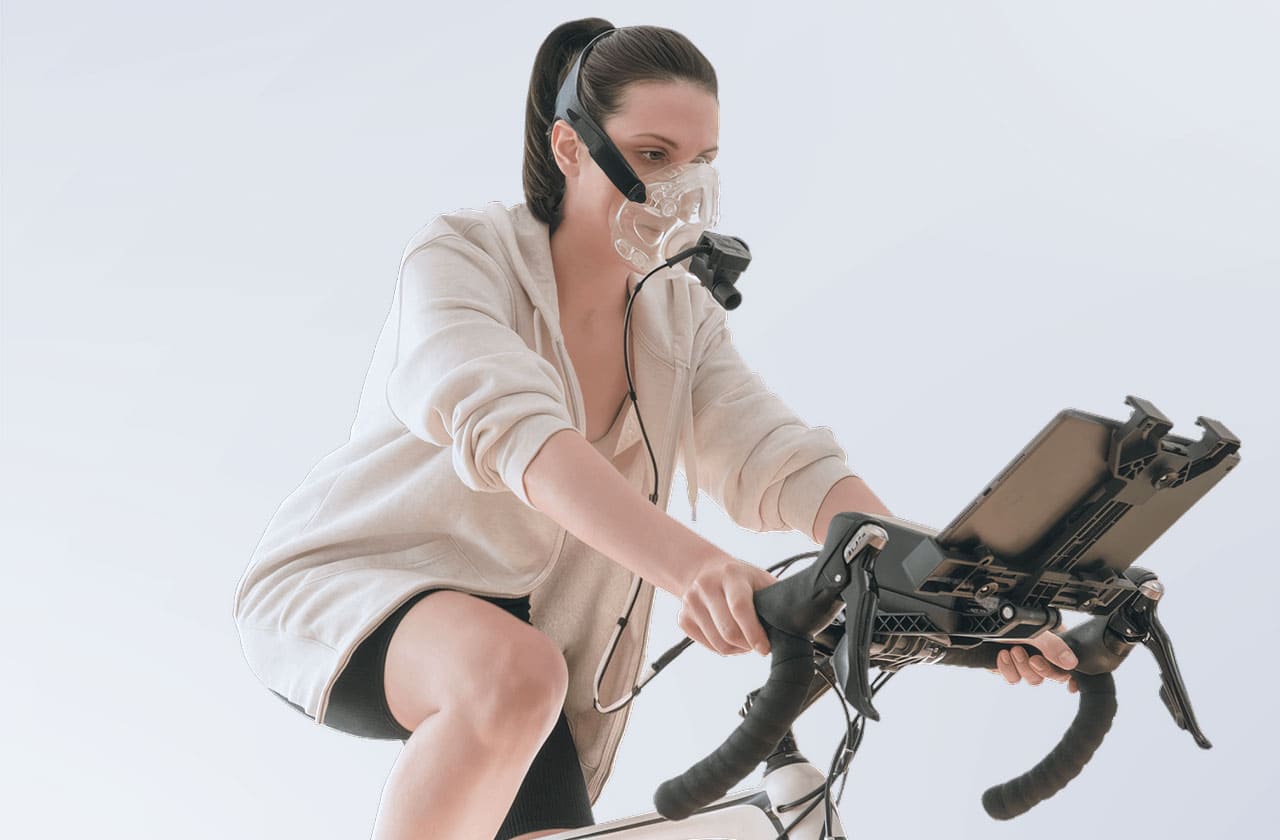
This test shows how energy expenditure and fuel use change at different exercise intensities. It also... VO₂ Max It allows us to take measurements.
VO₂ Max indicates the upper limit of the capacity of the heart, lungs, circulatory system, and muscles to work together to transport and utilize oxygen throughout the body. In other words, VO₂ max represents the maximum amount of oxygen the body can use in one minute during intense exercise and is usually expressed in ml/kg/minute. However, this simple number actually measures the combined performance of an extremely complex physiological system.
In terms of longevity, VO₂ max has a special significance among these parameters.
You may know your cholesterol level.
You may know your blood sugar level.
You may know your blood pressure, your weight, and even your body fat percentage.
Do you know your VO₂ max? If you don't know this, you might be missing out on some very important information regarding healthy aging.
The lungs need to take in oxygen from the air.
The heart needs to pump this oxygenated blood in sufficient quantities.
Blood vessels need to deliver blood to the working muscles.
Muscle tissue needs to be able to draw oxygen from the blood.
And finally, mitochondria need to use this oxygen to produce ATP, which is cellular energy.
Maximum aerobic capacity is limited when any link in this chain is insufficient. Therefore, VO₂ max is not just a measure of “lung capacity” or “fitness level,” but rather a functional stress test of how well the heart, lungs, circulatory system, muscle tissue, and mitochondria work together.
What does VO₂ Max tell us?
VO₂ max is one of the most important and objective indicators of cardiorespiratory fitness (CRF). In other words, it numerically represents the capacity of the heart, lungs, circulatory system, and muscles to transport and utilize oxygen during exercise. Therefore, VO₂ max is not only a value indicating athletic performance but also a physiological marker strongly associated with long-term health and lifespan.
One of the most striking examples of this is from 2018. JAMA Network OpenThis is a large study published in 1995 in which 122,007 people were evaluated. Participants were given a treadmill exercise test to determine their maximum effort capacity, and their exercise capacity was calculated in MET (metabolic equivalent) to determine their cardiorespiratory fitness levels. MET capacity is a measure of exercise capacity closely related to maximum oxygen consumption, i.e., VO₂ max. [1]
The adjusted risk of death for individuals in the lowest cardiorespiratory fitness group, i.e., those with the lowest VO₂ max, was found to be approximately five times higher than that of the “elite” fitness group. Moreover, the magnitude of the risk associated with low cardiorespiratory capacity was comparable to, and in some comparisons even higher than, well-known classic risk factors such as smoking, diabetes, and coronary artery disease. [1]
This finding is not limited to a single study. Numerous large cohort studies and meta-analyses have shown that as VO₂ max and cardiorespiratory fitness increase, the risk of all-cause death and cardiovascular mortality decreases. [2,3] Because of this relationship, the American Heart Association has recommended that cardiorespiratory fitness should not be overlooked in clinical assessments and should be considered a “clinical vital sign” like blood pressure and pulse. [2] VO₂ max is currently considered the most important indicator of longevity.
The PNOĒ system is unique because while standard exercise tests can estimate VO₂ max, cardiopulmonary exercise tests that analyze respiratory gases, like the PNOĒ, measure oxygen consumption directly through breath-by-breath analysis. Therefore, you learn your actual VO₂ max level, not just an estimated one.
What we are interested in is:What is the body's physical capacity in relation to its age?"
Fitness is a spectrum: even a slight improvement is important. Because the goal isn't for everyone to become an elite athlete. The goal is for individuals to increase their cardiorespiratory reserve relative to their starting level. For a sedentary person with low aerobic capacity, a reasonable increase in VO₂ max would be a very significant gain in terms of health.
In other words, you don't have to be "perfect" when it comes to fitness. However, it's extremely important not to remain at a very low fitness level.
Why does VO₂ Max become even more important as we age?
VO₂ max naturally tends to decrease with age. This is due to a decrease in maximum heart rate, a reduction in maximum cardiac output, loss of muscle mass, changes in peripheral circulation, and a decrease in the muscles' capacity to utilize oxygen. However, the decrease in VO₂ max with aging is not just a decrease in a laboratory number; it is also a decrease in physiological reserve.
When you're young, climbing stairs may only use a small fraction of your maximum capacity. In later years, the same stairs may require a much larger portion of your maximum aerobic capacity. Therefore, sufficient aerobic reserve is essential.
- being able to climb stairs,
- being able to walk fast,
- to be able to travel,
- to be able to shop,
- being able to mobilize again after illness or surgery,
- It becomes important in terms of extremely basic functions such as being able to independently carry out daily living activities.
VO₂ Max is a modifiable risk factor. This is perhaps VO₂ max's most valuable feature.
You cannot change your genetic makeup.
You cannot change your date of birth.
But you can significantly alter your cardiorespiratory capacity.
As a result of regular aerobic exercise, many physiological systems that determine VO₂ max, such as the heart's pumping capacity, muscle capillary density, mitochondrial capacity, and oxygen utilization efficiency, undergo adaptation.
Therefore, knowing one's VO₂ max is important not only for risk assessment but also for creating a personalized exercise program. The goal is not simply to measure the current value. The aim is to know the current level of cardiorespiratory fitness, to determine where the individual stands in relation to their age and population values, and to guide them to a healthier level in a targeted manner.
How can VO₂ Max be increased?
There is no single exercise method to improve aerobic capacity. Long-duration low-to-moderate intensity aerobic exercise supports a person's aerobic baseline and mitochondrial capacity. Higher-intensity interval training, however, provides a stronger stimulus to the heart's maximum output and maximum oxygen utilization capacity.
Therefore, for suitable individuals, incorporating both Zone 2 aerobic exercises and high-intensity interval training, tailored to the individual's health and fitness level, into the program is an effective strategy for achieving VO₂ max growth.
Resistance exercises should also be added to this. Because as we age, it is necessary to maintain not only cardiovascular capacity but also muscle mass and strength. Muscle mass is very important for a person to be able to live independently and maintain their mobility in old age.
Of course, it is very important for a person to seek advice from a doctor and fitness expert before starting an exercise program and to begin at a level appropriate to their age and current health parameters. A 70-year-old who has never exercised in their life should not start at the same level as a 20-year-old.
How is the PNOĒ test performed?
The PNOĒ test can be performed at rest or during exercise. Resting Test (RMR) It primarily provides information about basal metabolism, energy expenditure, and fuel use. It is a test administered while the person is at rest and while sitting.
Exercise test This test aims to evaluate a person's oxygen utilization, energy production, and cardiorespiratory capacity, and consequently their VO₂ max, under increased physical exertion. Depending on the individual's physical condition, a stationary bike or treadmill can be used for VO₂ max and active metabolism testing.
After a short warm-up period, exercise intensity is gradually increased. The load is increased in a controlled manner until the individual approaches the point where they can no longer continue, while respiratory gases are continuously analyzed. This allows for the evaluation not only of calories burned during exercise, but also of oxygen consumption, carbon dioxide production, and changes in energy metabolism at different intensities.
What should be considered before the test?
To ensure the results are as standardized as possible, certain conditions must be met before both tests.
- Ideally, an overnight fast of approximately 8–12 hours should be observed; water can be consumed.
- Caffeine, alcohol, nicotine, and other stimulants should not be consumed before the test.
- Some medications can affect heart rate or metabolic measurements. Regularly used medications should be reported to the doctor. Medication should not be discontinued without a doctor's recommendation..
- It is preferable to avoid strenuous exercise in the 24 hours prior to the test.
- Adequate sleep and hydration should be ensured before the test.
Strenuous exercise, sleep deprivation, dehydration, or excessive caffeine consumption before the test can affect a person's performance and therefore the measured values.
*** The PNOĒ test is not a replacement for any laboratory test, medical examination, or standard health screening. It is a complementary tool in the assessment of metabolic and cardiorespiratory capacity. The data obtained become more meaningful when interpreted together with the individual's medical history, physical examination, laboratory results, and other health assessments. Age, existing diseases, cardiovascular risk factors, and medications used should be considered, especially in individuals planning a maximum exercise test; a medical evaluation should be performed before the test if necessary.
I wish you healthy days,
Dr. Ahmet Özyiğit, MD, MSc, PgDip, FAAMM, ABAARM
Longevity Physician
Elite Research and Surgical Hospital
References
1. Mandsager K, Harb S, Cremer P, et al. Association of Cardiorespiratory Fitness With Long-term Mortality Among Adults Undergoing Exercise Treadmill Testing. JAMA Network Open. 2018;1(6):e183605. doi:10.1001/jamanetworkopen.2018.3605.
2. Ross R, Blair SN, Arena R, et al. Importance of Assessing Cardiorespiratory Fitness in Clinical Practice: A Case for Fitness as a Clinical Vital Sign. Circulation. 2016;134(24):e653-e699. doi:10.1161/CIR.0000000000000461.
3. Kokkinos P, Faselis C, Samuel IBH, et al. Cardiorespiratory Fitness and Mortality Risk Across the Spectra of Age, Race, and Sex. Journal of the American College of Cardiology. 2022;80(6):598-609. doi:10.1016/j.jacc.2022.05.031.